Astronomers observe rings forming around icy body Chiron between Saturn and Uranus; revealing how cosmic ring systems evolve | - The Times of India


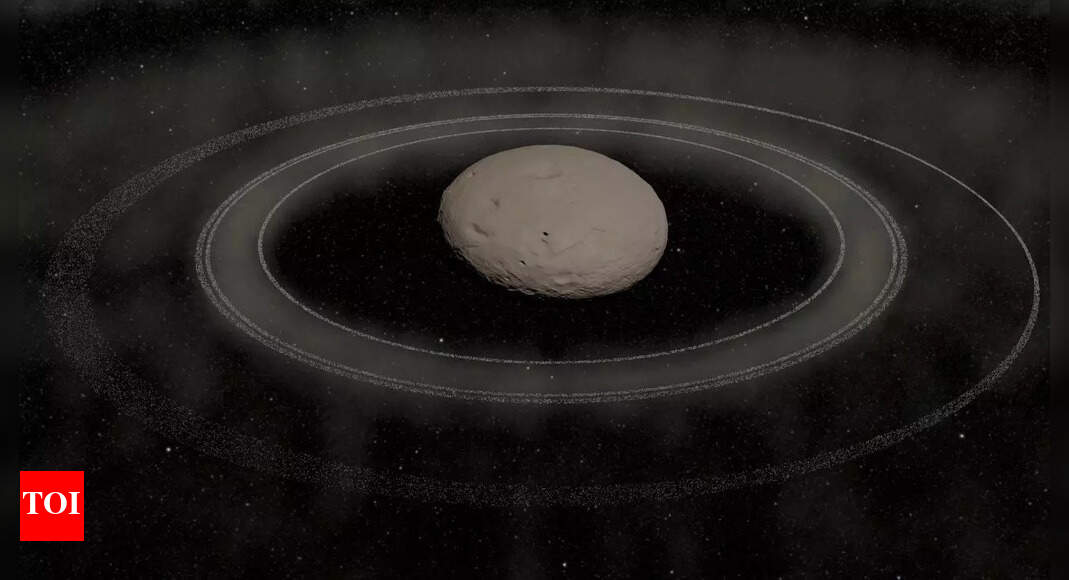
Astronomers have spotted a developing ring system around the centaur object 2060 Chiron, located between the orbits of Saturn and Uranus, providing a rare glimpse into how ring systems evolve around smaller icy bodies. The observations, drawing on data from 2011, 2018, 2022 and a detailed campaign in 2023 at the Pico dos Dias Observatory in Brazil, revealed four distinct rings and surrounding diffuse material. The inner rings lie hundreds of kilometres from Chiron’s centre, while a more distant fourth ring sits around 1,400 km away, hinting at dynamic changes over time. Analyses suggest the rings are primarily composed of water ice — similar in composition to those of Saturn — and that the system is actively evolving, possibly through collisions, debris shedding or the breakup of a small moon. Beyond illuminating Chiron’s story, this discovery sheds light on disc-dynamics and satellite formation in broader cosmic settings.
The Key points
- The object Chiron is classed as a centaur — a small body orbiting between the giant planets and showing both asteroid and comet-like traits.
- Researchers identified three inner rings at approximately 273 km, 325 km and 438 km from Chiron’s centre, plus a tentative fourth ring ~1,400 km out.
- Compared with earlier observations, the ring system shows measurable changes — direct evidence of ring evolution in real time.
- The rings around Chiron are believed to consist largely of water ice, aiding their stability and preventing moon-formation.
- These rings may have originated from debris released after a small moon’s destruction, impacts on Chiron, or material ejected by Chiron itself.
- Chiron’s orbit takes about 50 years around the Sun and it spans roughly 200 km in diameter.
- The discovery adds Chiron to the exclusive list of small solar-system bodies known to carry rings, joining objects like 10199 Chariklo, Haumea and Quaoar.
- By studying a ring system around a modest-sized body, scientists gain insight into how ring and moon systems might form on a variety of scales.
- The ring system’s evolution underscores the role of water-ice and dust dynamics in sculpting disc structures around bodies beyond the major planets.
- This finding broadens our understanding of planetary-formation processes and shows that ring systems aren’t confined just to large gas giants.
Disclaimer: This preview includes title, image, and description automatically sourced from the original website (timesofindia.indiatimes.com) using publicly available metadata / OG tags. All rights, including copyright and content ownership, remain with the original publisher. If you are the content owner and wish to request removal, please contact us from your official email to no_reply@newspaperhunt.com.