P-wave magnetism in a metal | Nature Materials


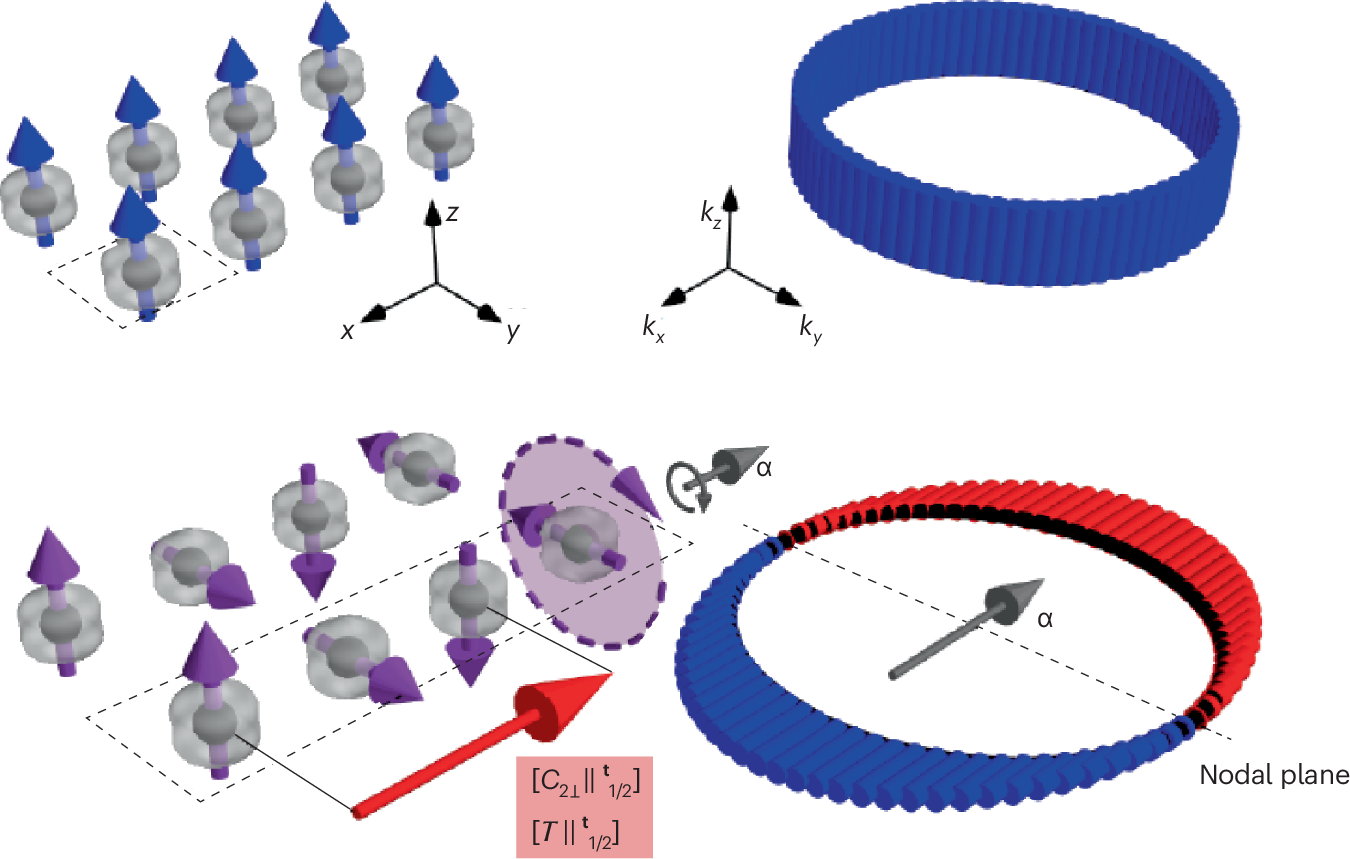
Researchers have demonstrated that a particular metallic compound can exhibit a rare form of magnetism — p-wave magnetism — by carefully arranging its internal magnetic structure. In this material, an antiferromagnetic "background" of localized magnetic moments interacts with mobile conduction electrons in such a way that the electronic band structure becomes spin-split in a momentum-dependent (p-wave) manner. The team achieved this by starting with a compound grounded in a magnetic helical order and then adjusting its composition so the helix becomes commensurate with the crystal lattice. Using resonant elastic X-ray scattering, they confirmed a precise magnetic ordering vector, showing that the spin helix is coplanar and lattice-commensurate. This discovery opens up a new path to integrating unconventional magnetic orders in metals, which could be promising for future spintronic applications.
The Key points
- A novel p-wave type of magnetism has been realized in a metallic system through coupling between localized antiferromagnetic moments and itinerant conduction electrons.
- The starting material was identified as a helimagnet — a metal whose magnetic moments form a helical structure.
- By substituting a small amount of one element (Rh for Ru), researchers fine-tuned the helix so that it becomes commensurate with the underlying crystal lattice.
- The resulting spin helix has a magnetic ordering vector kₘₐg = (1/6, 1/6, 0), demonstrating a precise periodicity matching the crystal.
- The spin helix is coplanar, meaning the spins lie in a common plane rather than being randomly oriented.
- Momentum-space electronic structure exhibits spin splitting characteristic of a p-wave magnetic order — distinct from conventional ferromagnetic (s-wave) splitting.
- This work provides a concrete example where spatial magnetic order (in real space) directly shapes electron behavior in momentum space.
- The discovery suggests a new route to designing magnetic metals with unconventional spin textures — potentially useful in spintronics and quantum materials research.
- Because the magnetism arises from itinerant electrons interacting with localized moments, this p-wave order may combine metallic conductivity with nontrivial spin behavior.
- The approach highlights the importance of symmetry and lattice commensurability in stabilizing complex magnetic orders in metals — offering a blueprint for discovering more exotic magnetic states.
Disclaimer: This preview includes title, image, and description automatically sourced from the original website (www.nature.com) using publicly available metadata / OG tags. All rights, including copyright and content ownership, remain with the original publisher. If you are the content owner and wish to request removal, please contact us from your official email to no_reply@newspaperhunt.com.