Indian scientists spot 12-billion-year-old Milky way-like galaxy in Webb images


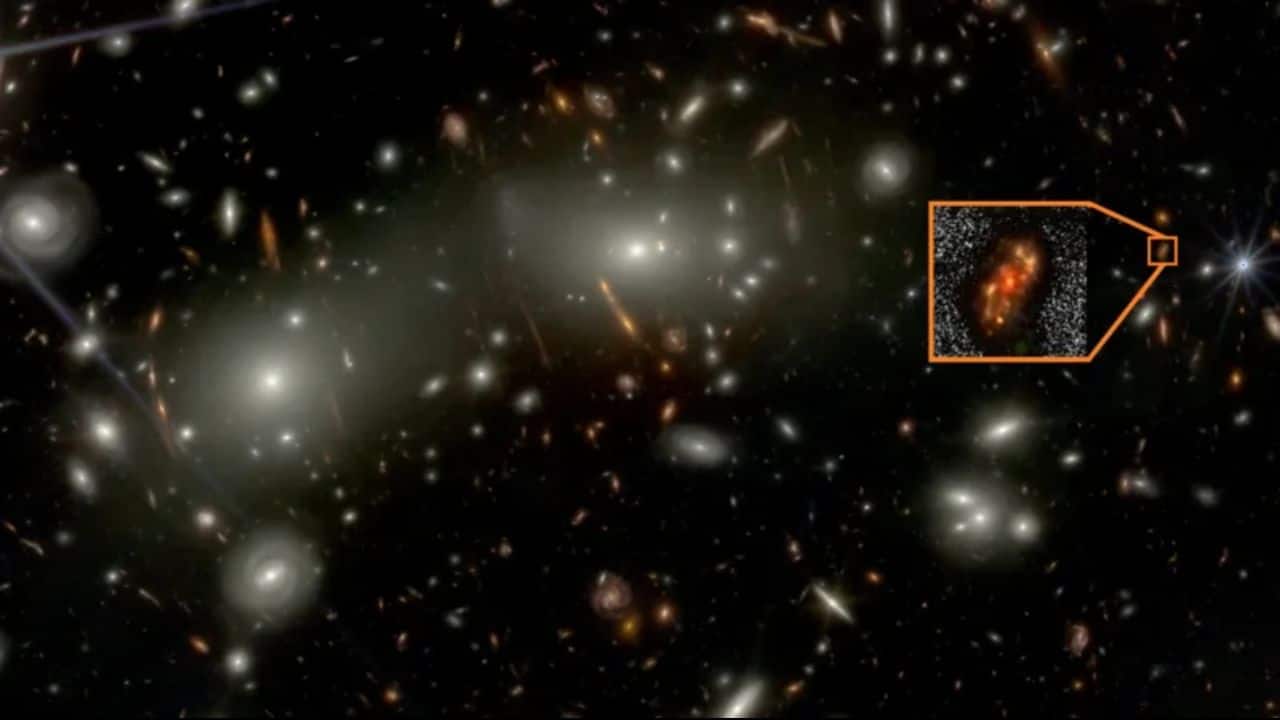
Astronomers in India have identified an extraordinary galaxy—named Alaknanda—that existed just 1.5 billion years after the Big Bang. Using images from the James Webb Space Telescope (JWST), researchers found that Alaknanda displays a well-defined spiral structure, complete with sweeping arms and a bright central bulge — a striking resemblance to our own Milky Way. Measuring nearly 30,000 light-years across and containing roughly 10 billion solar masses, this galaxy defies long-standing views that early galaxies were chaotic, small and irregular. Instead, Alaknanda reveals that complex, orderly galaxies could form much sooner than previously believed, forcing astronomers to rethink how rapidly cosmic structures emerged after the Universe’s infancy.
The Key points
- The galaxy, now called Alaknanda, is observed as it was 12 billion years ago — only 1.5 billion years after the Big Bang.
- It exhibits a complete spiral morphology with two symmetrical arms and a bright central bulge — a Milky Way-like structure.
- Alaknanda spans about 30,000 light-years, making it surprisingly large for a galaxy from that early era.
- Its total stellar mass is estimated around 10 billion times the mass of our Sun, indicating rapid mass build-up.
- The arms also show “beads-on-a-string” patterns of star clusters, similar to those seen in nearby modern spirals.
- The galaxy lies behind a massive cluster, and gravitational lensing helped magnify and resolve its structure using JWST.
- Its discovery challenges traditional theories that early galaxies were small, irregular, and chaotic.
- The rapid appearance of such a mature, organised galaxy suggests the early universe was capable of more complex, accelerated galaxy formation than previously assumed.
- According to researchers, galaxies like Alaknanda may be rare — only one was found among roughly 70,000 objects examined.
- The find opens up questions about the mechanisms and conditions that allowed such structured, massive galaxies to assemble so early, motivating further observations and study.
Disclaimer: This preview includes title, image, and description automatically sourced from the original website (www.moneycontrol.com) using publicly available metadata / OG tags. All rights, including copyright and content ownership, remain with the original publisher. If you are the content owner and wish to request removal, please contact us from your official email to no_reply@newspaperhunt.com.