ISRO Releases Advance Chandrayaan-2 Radar Data Products For Global Scientists Studying Moon’s Polar Regions


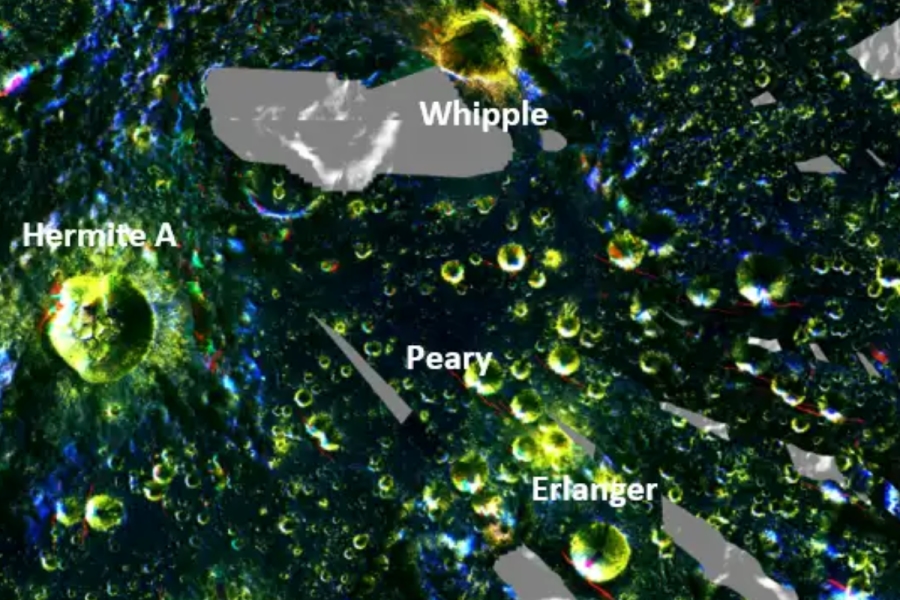
India’s Indian Space Research Organisation (ISRO) has unveiled a significant release of advanced radar-derived data products from the Chandrayaan‑2 Orbiter mission, aimed at enabling scientists globally to study the Moon’s polar regions more deeply. Leveraging the orbiter’s Dual Frequency Synthetic Aperture Radar (DFSAR) instrument, which operates in full-polarimetric mode and provides data at a resolution of about 25 metres per pixel, the agency has processed around 1,400 radar datasets and developed ready-to-use mosaic maps covering latitudes between 80° and 90° in both hemispheres. These products include parameters such as circular polarisation ratio (CPR), surface roughness indicators, and dielectric constants, shedding light on features like potential water-ice deposits, regolith density and porosity. Released freely via ISRO’s data archive, these datasets are poised to support future lunar exploration efforts and help characterise the Moon’s least-explored terrain.
The Key points
- ISRO’s Chandrayaan-2 orbiter has operated since 2019 and now contributes high-resolution radar data of lunar poles.
- The DFSAR payload is the first to map the Moon in full-polarimetric L-band mode at ~25 m/pixel resolution.
- Approximately 1,400 radar datasets were processed to create polar mosaics covering the Moon’s north and south polar regions (80°–90° latitude).
- The resulting data products include the circular polarisation ratio (CPR), which is sensitive to subsurface ice presence.
- Other derived parameters cover surface roughness (single-bounce eigenvalue relative difference) and dielectric constant (via T-Ratio).
- Polarimetric decomposition components (odd, even, volume, helix scattering) are included to characterise radar-scattering behaviours.
- ISRO highlights that lunar polar regions may preserve early solar-system chemical signatures and are key for future missions.
- The Level-3C “Polar Mosaics” are now freely available for researchers via ISRO’s data portal at the Indian Space Science Data Centre (ISSDC).
- These datasets complement hyperspectral and other remote-sensing data for better mapping of lunar minerals and resources.
- The release underscores India’s growing role in lunar science and deepens opportunities for international collaboration on Moon polar research.
Disclaimer: This preview includes title, image, and description automatically sourced from the original website (swarajyamag.com) using publicly available metadata / OG tags. All rights, including copyright and content ownership, remain with the original publisher. If you are the content owner and wish to request removal, please contact us from your official email to no_reply@newspaperhunt.com.